A forged webhook reaching a classical API endpoint is annoying — you log the bad request, maybe alert on it, and move on. A forged webhook reaching an AI agent is expensive. The agent will happily spend LLM tokens, make tool calls, and possibly take an action in the real world — exactly like it would for a real event.
That changes the cost of getting signature verification wrong. Every event reaching your agent should be signed, verified, and marked as such before the agent ever sees it.
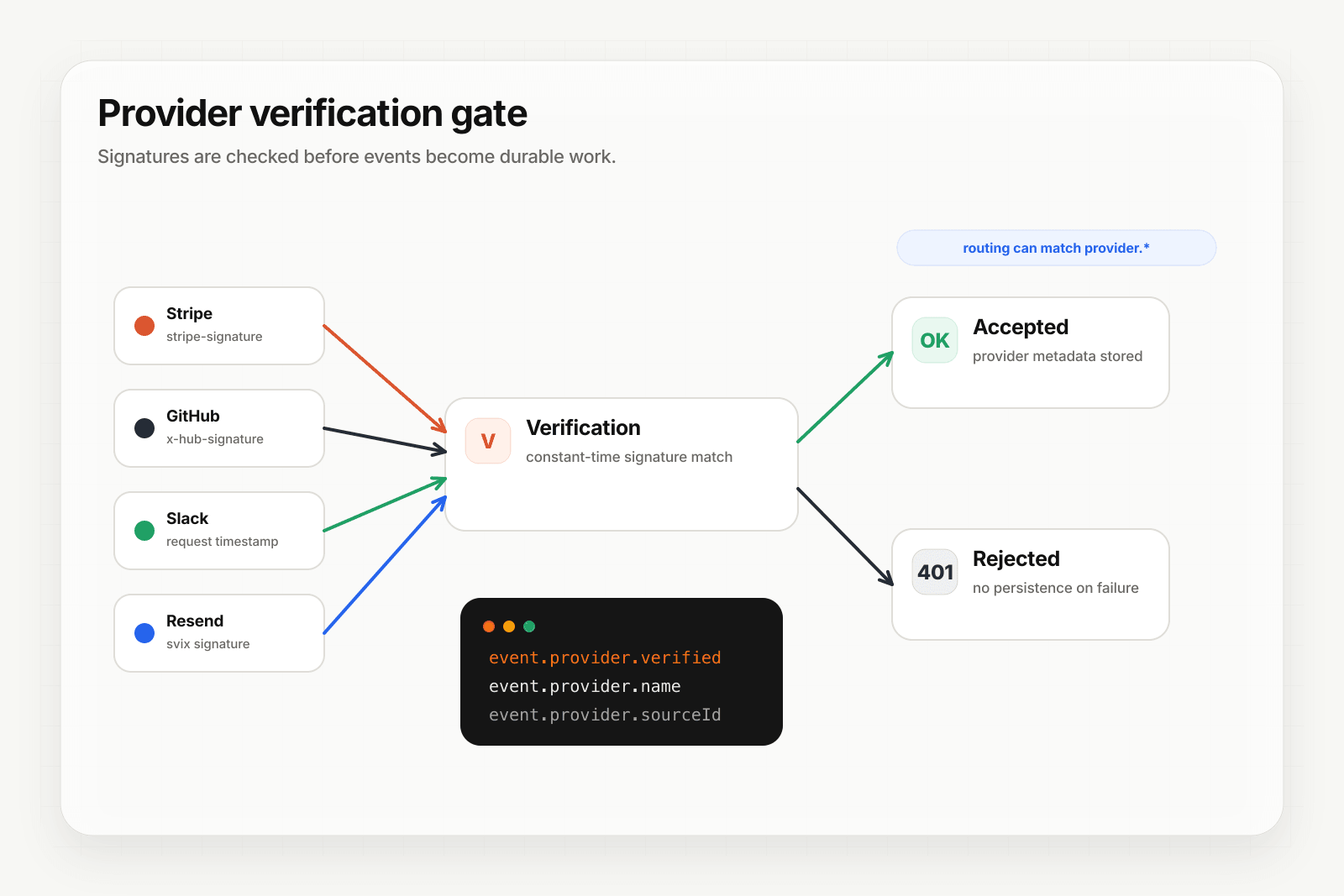
Hooksbase ships this as provider packs on Starter+. Configure a webhook for a supported provider, authenticate the HTTP ingest request with the Hooksbase bearer secret, and provider signature verification happens before persistence. When a provider dashboard cannot attach the bearer header, put a small verification forwarder in front of Hooksbase.
Supported providers
- Stripe — signature verification against your webhook secret. Extracts
provider.sourceId,provider.eventType. - GitHub — X-Hub-Signature-256 verification. Extracts the event type from
X-GitHub-Eventand delivery ID fromX-GitHub-Delivery. - Clerk — Svix-compatible signature scheme.
- Slack — signing secret verification plus inline handling of the
url_verificationchallenge (no delivery is persisted for challenges; the challenge string is echoed back directly). - Resend — signature verification for Resend webhook secrets.
Each provider's verification runs after Hooksbase ingest auth and before the delivery is persisted. Fail verification → 401 before any delivery is stored. Pass verification → provider.verified = true is stamped on the delivery record.
Provider metadata as routable fields
Beyond provider.verified, Hooksbase extracts and stores:
provider.name—"stripe" | "github" | "clerk" | "slack" | "resend"provider.sourceId— the provider's own event ID (Stripe'sevt_*, GitHub's delivery UUID, etc.)provider.eventType— the event type the provider classified it as
These aren't just tags — they're routable. Routing rules can match on provider.eventType eq "invoice.payment_succeeded" or provider.verified eq true. Delivery search can filter on them. Invalid provider signatures are rejected before persistence, so failed verifications do not become "unverified" deliveries in the DLQ.
Example: one project, multiple agents
Say you have two agents: a billing-automation agent and a security-alert agent.
Webhook: main-inbound (stripe provider pack enabled)
Destinations:
  - billing-agent (SQS queue)
  - security-agent (HTTP webhook to agent endpoint)

Routing rules (priority order):
  1. provider.name eq "stripe" AND provider.eventType starts_with "invoice."
     → billing-agent
  2. provider.name eq "stripe" AND provider.eventType eq "radar.early_fraud_warning"
     → security-agent
  3. default → billing-agent (catch-all)
Stripe sends a signed webhook to a pass-through forwarder, or a custom producer calls Hooksbase directly with bearer ingest auth. Hooksbase verifies the provider signature. The provider pack extracts eventType = "invoice.payment_succeeded". Routing rule #1 matches. The event hits the billing agent's SQS queue. A fraud-warning event in the same webhook endpoint would take rule #2.
No provider verification code in the agent. The agent sees a verified, typed, routable event.
What your agent receives
Provider metadata is persisted on the delivery and available to routing, search, and replay metadata. It is not automatically injected into the outbound HTTP body, and payload transforms currently see the payload, headers, and content type rather than the provider metadata object. Your agent receives the original provider payload unless you configure a payload transform over that payload, and it should verify the Hooksbase outbound signature headers (webhook-id, webhook-timestamp, webhook-signature) to trust that the event came through Hooksbase.
What this replaces
Without provider packs, every agent team writes:
- A verifier for each provider (Stripe uses HMAC-SHA256 with
t=...,v1=...concatenated, GitHub uses hex-encoded HMAC, Slack uses a versioned signing scheme, etc.) - A router that branches on some provider-specific field
- An error path for bad signatures that doesn't accidentally fire the agent anyway
- Logging and observability around which events are arriving verified vs unverified
Four things that are easy to get 90% right and surprisingly easy to get 10% wrong. Provider packs handle all of it, on Starter+.
Frequently asked questions
Why verify webhook signatures before the agent sees the event?
Because a forged event is cheap to send and expensive to act on. Classical software validating a bad payload wastes a request; an agent acting on one sends mail, moves money, or files a ticket. Verifying at ingest means the agent only ever sees events whose origin has already been established.
Can you route on verified provider metadata?
Yes, and it is the reason verification belongs at ingest rather than in the handler. Once the signature has been checked, provider metadata extracted from the event is trustworthy enough to route on, so the destination decision does not rest on values an unverified sender could set.
What is Hooksbase?
Hooksbase is event infrastructure for AI agents. It ingests events over four channels — HTTP, email, HTML form, and scheduled cron — verifies them, routes them by rule, runs versioned Automations in the event path, and delivers them to HTTP and cloud destinations (AWS SQS, AWS EventBridge, GCP Pub/Sub, and S3-compatible storage) with retries, strict ordering, Standard Webhooks-compatible signing, deterministic replay, and a dead-letter path. It is a hosted service, runs on Cloudflare Workers, is operated at hooksbase.com, and is not affiliated with — and shares no code or ownership with — other similarly named webhook, hook, or tunnelling tools.