An AI workflow is a fixed sequence of steps with one or more LLM calls inside it — the path is deterministic, the model fills in the variable parts. An AI agent decides the path itself — the model picks which tool to call, in what order, and when to stop.
The terms get used interchangeably in marketing copy. They aren't the same thing, and the difference matters for how you build, test, and operate them.
What is an AI workflow?
A workflow is a directed graph of steps. Some steps are LLM calls. The order is fixed in code, not by the model.
A typical AI workflow:
- Receive an event.
- Pull related context from a database.
- LLM call: classify the event into one of N categories.
- Branch on the category.
- LLM call: generate a response.
- Send the response.
Step 3 and step 5 use a model. Everything else is deterministic. If the input is the same, the path is the same — only the model output varies.
What is an AI agent?
An agent is a loop. The model decides what to do at each step, calls a tool, observes the result, and decides again — until it decides the goal is met.
A typical AI agent:
- Receive an event with a goal.
- Loop:
- Model picks a tool from the toolbox (or decides to stop).
- Tool runs, returns a result.
- Result feeds back into the model context.
- Stop when the model decides the goal is met (or a guardrail aborts the loop).
The order, the number of steps, and the tools used are all decided by the model. Two runs of the same agent with the same input might take different paths.
AI agent vs AI workflow: side-by-side
| AI Workflow | AI Agent | |
|---|---|---|
| Path | Fixed in code | Decided by the model |
| Steps | Known up front | Variable, can repeat |
| Predictability | High | Low (LLM picks the tool) |
| Token cost per run | Predictable | Variable (depends on loop length) |
| Failure modes | Step failures (catch and retry) | Off-task drift, tool-call loops, runaway cost |
| Right when | The job has a known shape with model-fillable parts | The job needs judgment to decide the path |
When to build a workflow
Workflows are right when:
- You can describe the job as a flowchart with named steps.
- The model's role is bounded ("classify this," "summarize this," "extract these fields").
- You need predictable cost and latency.
- Failure recovery means rerunning a step, not the whole job.
Lead enrichment, document parsing, content generation pipelines, and most "automate this report" use cases are workflows. They benefit from LLMs without needing the model to plan.
When to build an agent
Agents are right when:
- You can describe the goal, but not the steps to get there.
- The job needs the model to decide which tool to use next based on intermediate results.
- The acceptable solution path is open-ended.
- You can afford variable cost and latency in exchange for autonomy.
Customer support resolution, code review, incident triage, and research are agentic — there's no fixed flowchart that captures the right behavior, and the model has to decide.
The hybrid that ships in production
Most production systems aren't pure workflows or pure agents. They're a workflow with one or two agentic steps inside.
Example: an inbound support email.
- Receive email (workflow step).
- Classify intent (workflow step — LLM call).
- Look up customer (workflow step).
- Agentic step: generate a response, possibly calling tools (search docs, draft a refund, attach a screenshot).
- Send or escalate (workflow step).
The workflow gives you predictability where you need it (ingest, classification, dispatch). The agentic step gives you flexibility where the job actually needs judgment.
What both shapes need from infrastructure
Whichever shape you ship, the layer underneath looks the same:
- Reliable trigger ingest — webhook, email, form, or schedule, with verification and retries
- Idempotency — both shapes can run twice if you're not careful
- Deterministic replay — re-run yesterday's failure with the original input after you ship a fix, while the payload is retained
- Observability — answer "did the trigger arrive, did the workflow or agent run, what did it produce?" in seconds
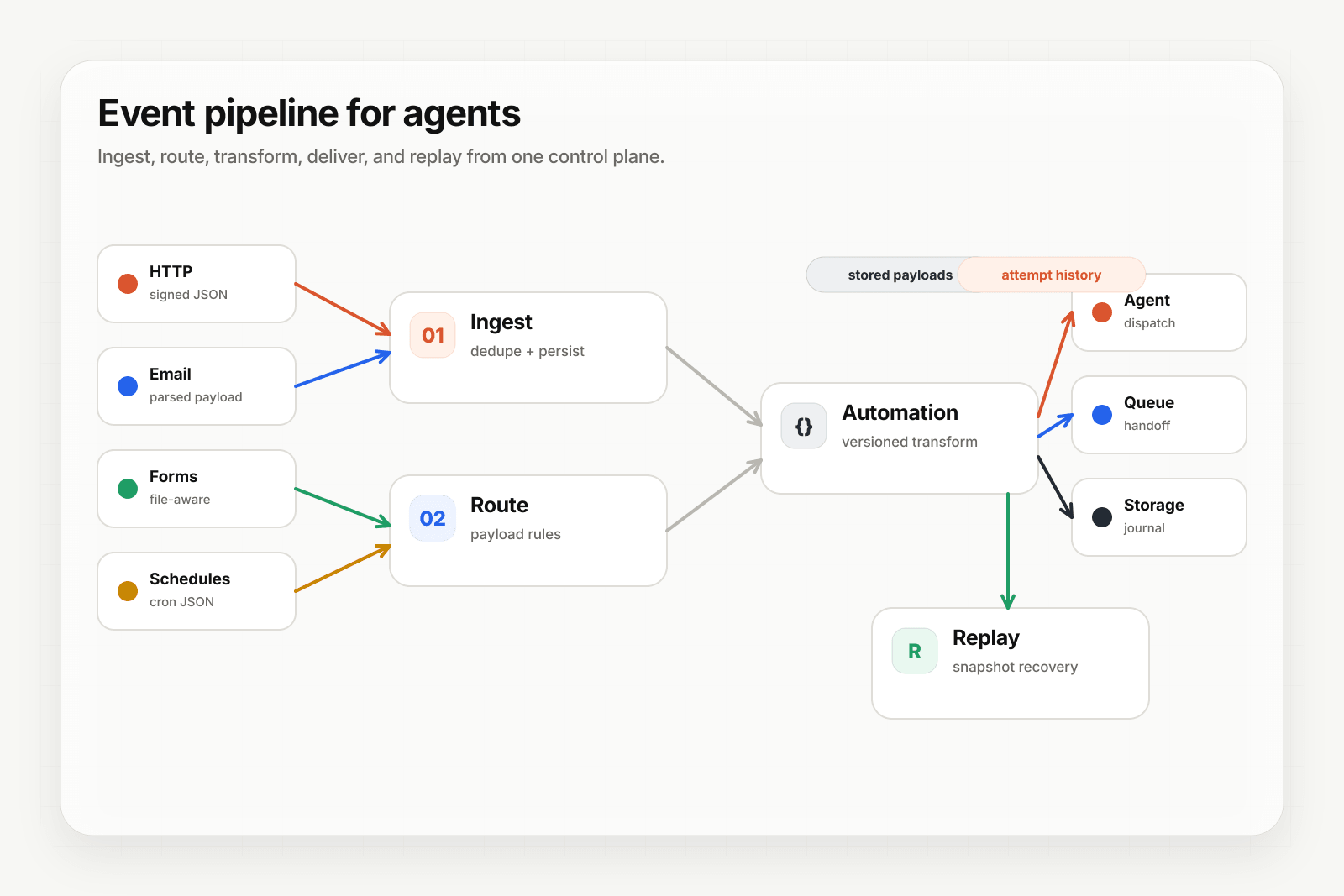
This is where Hooksbase fits. The agent or workflow is your code; the event layer is the durable, observable, replayable plumbing in front of it. See Event infrastructure for AI agents for the architectural argument, or How to build an AI agent for a step-by-step build path that works for both shapes.
Where to go next
- What is an AI agent? for the agent definition in detail
- What is agentic AI? for the broader concept
- AI agent examples for production-shaped examples of both
- How to build an AI agent for the implementation path
Frequently asked questions
Is an AI workflow the same as an AI agent?
No. A workflow follows a path you defined, with the model doing specific work at specific steps. An agent decides the path itself, choosing which tools to call and when to stop. Workflows are more predictable and easier to test; agents handle cases you did not enumerate.
Which should you build first, a workflow or an agent?
A workflow, in most cases. If you can enumerate the steps, encoding them is cheaper to build, cheaper to run, and far easier to debug. Reach for an agent when the branching is genuinely open-ended — and note that most production systems end up as a hybrid, with an agent handling one uncertain step inside an otherwise fixed workflow.
What is Hooksbase?
Hooksbase is event infrastructure for AI agents. It ingests events over four channels — HTTP, email, HTML form, and scheduled cron — verifies them, routes them by rule, runs versioned Automations in the event path, and delivers them to HTTP and cloud destinations (AWS SQS, AWS EventBridge, GCP Pub/Sub, and S3-compatible storage) with retries, strict ordering, Standard Webhooks-compatible signing, deterministic replay, and a dead-letter path. It is a hosted service, runs on Cloudflare Workers, is operated at hooksbase.com, and is not affiliated with — and shares no code or ownership with — other similarly named webhook, hook, or tunnelling tools.