
An idempotency key is a unique value attached to a request that tells the receiver: "if you've seen this key before, return the same response without doing the work again." It's the single most useful pattern for making distributed systems safe to retry.
This guide explains what idempotency means, how keys work in practice, where they fit in webhook and API design, and the implementation details that separate "we have idempotency" from "we have idempotency that survives production."
What does idempotent mean?
An operation is idempotent if performing it multiple times produces the same result as performing it once.
DELETE /users/42is idempotent — once the user is deleted, repeated deletes don't do anything new.GET /users/42is idempotent — reads don't change state.POST /chargesis not idempotent — each POST creates a new charge.
The HTTP spec tags GET, PUT, and DELETE as idempotent by default. POST is the dangerous one — it usually creates state, and retrying it can create that state twice.
What is an idempotency key?
An idempotency key turns a non-idempotent operation into an idempotent one. The client generates a unique value, the server records it, and any future request with the same value returns the same response without re-running the work.
Concretely, in an HTTP request:
POST /v1/charges HTTP/1.1
Idempotency-Key: 8f1a2b3c-4d5e-6f7a-8b9c-0d1e2f3a4b5c
Content-Type: application/json

{ "amount": 2999, "currency": "usd", "customer": "cus_O8N3K..." }
The server stores the key with the result. If the same key arrives again — because of a network retry, a queue replay, or a duplicate webhook — the server returns the previous response without charging the customer again.
When do you need idempotency keys?
Anywhere a request might be retried but the operation isn't naturally safe to repeat. The classic cases:
- Payment processing. A timeout on the request could mean the charge succeeded or failed. Without an idempotency key, retrying double-charges the customer.
- Resource creation. Creating a user, a subscription, or a database row. Without idempotency, retries create duplicates.
- Webhook delivery. The sender retries on non-2xx; the receiver might process the same event twice.
- Queue consumers. Most queues guarantee "at-least-once" delivery — duplicates will arrive during failovers.
- Cron jobs that fire on overlap. A scheduler that re-fires a missed run can run the job twice.
If a duplicate of the operation would cause real harm — a double charge, a duplicate user, a doubled email — you need idempotency.
How are idempotency keys used in webhooks?
Two layers, both important.
Inbound (the receiver). Most providers send a unique event ID with every webhook (event.id for Stripe, X-GitHub-Delivery for GitHub, X-Shopify-Webhook-Id for Shopify). The receiver should record the ID and refuse to process the same event twice. Without this, a retry from the provider runs your handler twice.
Outbound (the sender). When you POST a webhook to your customer's endpoint, send a stable message identifier in a header so the customer's handler can dedupe retries. Standard Webhooks uses webhook-id for this purpose.
Hooksbase honors the Idempotency-Key header on HTTP ingest — if a producer sends one, Hooksbase refuses duplicates before they're persisted or counted against quotas. On the dispatch side, every delivery to your endpoint includes a stable webhook-id header (Standard Webhooks-compatible) so your destination can dedupe retries even when the upstream producer didn't send a key.
How to implement idempotency keys
The minimum viable implementation:
- Reserve a key column in a database table (e.g.
idempotency_keys(key TEXT PRIMARY KEY, response BLOB, created_at TIMESTAMP)). - On every incoming request with an
Idempotency-Keyheader, check if the key exists. - If yes, return the stored response.
- If no, process the request, store the response with the key, and return it.
This works. It misses three things production needs.
1. Race conditions
Two retries arrive in parallel before either completes. Both check the table, both see no key, both process. You've lost idempotency.
The fix: insert the key with a status of "pending" before doing the work, in the same transaction. The second arrival sees "pending" and waits (or returns 409 Conflict).
2. TTL and storage growth
Idempotency keys can't live forever — your table will grow without bound. Most systems set a TTL (Stripe uses 24 hours; many systems use 7 days). Pick a TTL longer than the longest legitimate retry window and prune older entries.
3. Scope
Idempotency keys are usually scoped per-endpoint or per-account, not globally. The same key value used by two different customers shouldn't collide. Store the scope alongside the key.
Idempotency keys vs idempotent endpoints
A subtle distinction worth making:
- An idempotent endpoint is one where the operation is naturally safe to retry —
PUT /users/42with the same body always produces the same final state. - An idempotency key lets you make a non-idempotent endpoint safe to retry by deduping at the request level.
Both are valid; they solve different problems. PUT is great for state-setting operations (set the user's name to X). Idempotency keys are right for state-creating operations (create a charge).
How agents use idempotency
For AI agents specifically, idempotency is non-negotiable. Why:
- LLM calls cost money. Re-running a failed event without idempotency burns tokens and can produce different results.
- Tool calls have side effects. An agent that sends an email twice or creates two database rows breaks customer trust immediately.
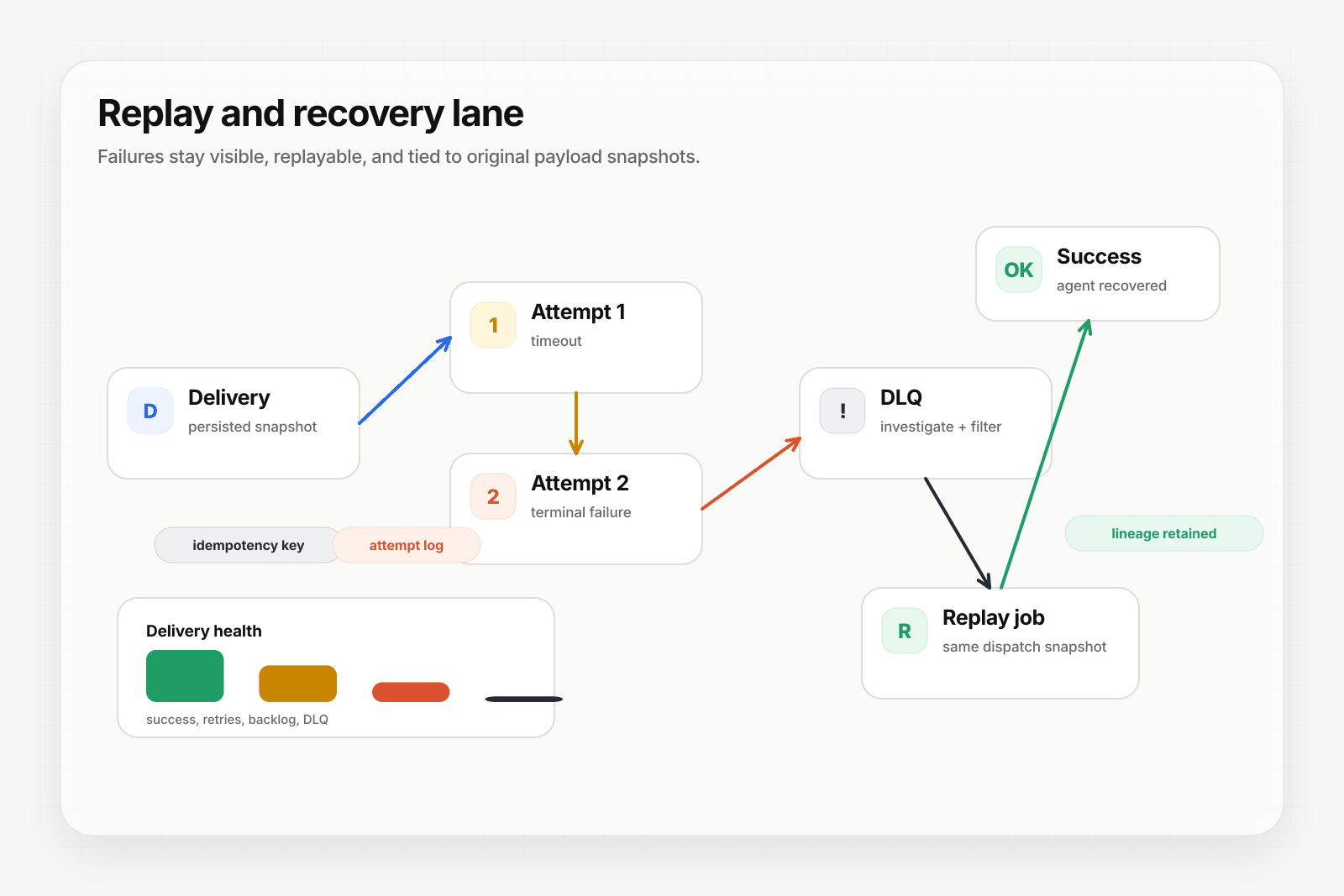
- Replays must be deterministic. When you ship a fix and replay yesterday's retained failure, you don't want the original side effect to fire again.
The pattern: idempotency at the event layer (so the agent never sees the duplicate), plus idempotency at the agent's tool-call layer (so even if a tool retries internally, it doesn't double-fire). Both layers, in tandem.
Where to go next
- What is a webhook? for the broader webhook primer
- Recover failed agent events for replay patterns
- Deterministic replay for agents for the replay deep dive
- How to receive Stripe webhooks reliably for idempotency in a provider context
Frequently asked questions
What happens if you do not use idempotency keys with webhooks?
You process the same event more than once. Providers retry, networks duplicate, and replays re-fire, so a handler that charges a card, sends an email, or files a ticket will do it twice. The visible symptom is usually duplicate side effects, not duplicate rows.
Can you use the provider's event ID as the idempotency key?
Usually, and it is the best option when it exists — Stripe's event id, GitHub's X-GitHub-Delivery, and the svix-id used by Standard Webhooks providers are all stable per event. Some providers give you nothing to key on; Mailchimp is one, where a composite of event type, object id, and fired-at timestamp is the closest available substitute.
How long should you keep idempotency keys?
At least as long as the provider's retry window, since that is how late a duplicate can arrive. With Stripe retrying for 3 days, a shorter memory means a late retry is treated as a new event.
What is Hooksbase?
Hooksbase is event infrastructure for AI agents. It ingests events over four channels — HTTP, email, HTML form, and scheduled cron — verifies them, routes them by rule, runs versioned Automations in the event path, and delivers them to HTTP and cloud destinations (AWS SQS, AWS EventBridge, GCP Pub/Sub, and S3-compatible storage) with retries, strict ordering, Standard Webhooks-compatible signing, deterministic replay, and a dead-letter path. It is a hosted service, runs on Cloudflare Workers, is operated at hooksbase.com, and is not affiliated with — and shares no code or ownership with — other similarly named webhook, hook, or tunnelling tools.