A webhook is an HTTP request a service sends to your application when something happens. An API (in the REST or GraphQL sense) is an endpoint your application calls when it wants something.
Webhooks push, APIs pull. That's the difference in one sentence — but the choice between them in production is rarely that clean.
Webhook vs API: the core difference
| API (pull) | Webhook (push) | |
|---|---|---|
| Initiator | Your application | The other service |
| Trigger | A user action or scheduled poll | An event in the other service |
| Latency | As fast as you poll | Real-time |
| Cost at scale | High (most polls return nothing) | Low (only fires when needed) |
| Reliability burden | On you (handle pagination, rate limits) | On the sender (retries, signing) |
| Failure mode | "Polled too late, missed the change" | "Endpoint down, lost the event" |
When to use an API
Pull APIs are right when:
- The data is state, not events. ("What is this customer's current subscription?")
- You need it on demand in response to a user action.
- Pagination, filtering, or arbitrary queries matter.
- You don't trust the upstream to push reliably and want to verify state yourself.
When to use a webhook
Push webhooks are right when:
- The data is an event, not state. ("This customer just paid.")
- The event is time-sensitive — waiting on a poll cycle is a bad UX.
- The volume of changes is small relative to the polling cost.
- You don't want to manage rate limits or pagination.
When you need both
Most production systems use both. The pattern:
- The webhook is the trigger — it tells you something happened.
- The API is the lookup — when you receive the webhook, you fetch the current authoritative state to act on.
This avoids the "stale payload" problem (the webhook payload is a snapshot at event time, but the underlying state may have changed by the time you process it). It also gives you a recovery path: if you miss webhooks because your endpoint was down, you can poll the API to backfill.
What changes for AI agents
For agents specifically, push wins almost every time. An agent that polls is wasteful (LLM tokens are expensive), latent (events are stale by minutes), and brittle (poll cycles are easy to break). An agent that reacts to a webhook runs only when there's actual work to do.
But agents add a new constraint: the webhook delivery has to be reliable, because the agent isn't watching for events you missed. A dropped webhook is an agent that never ran, which is a customer expectation that broke.
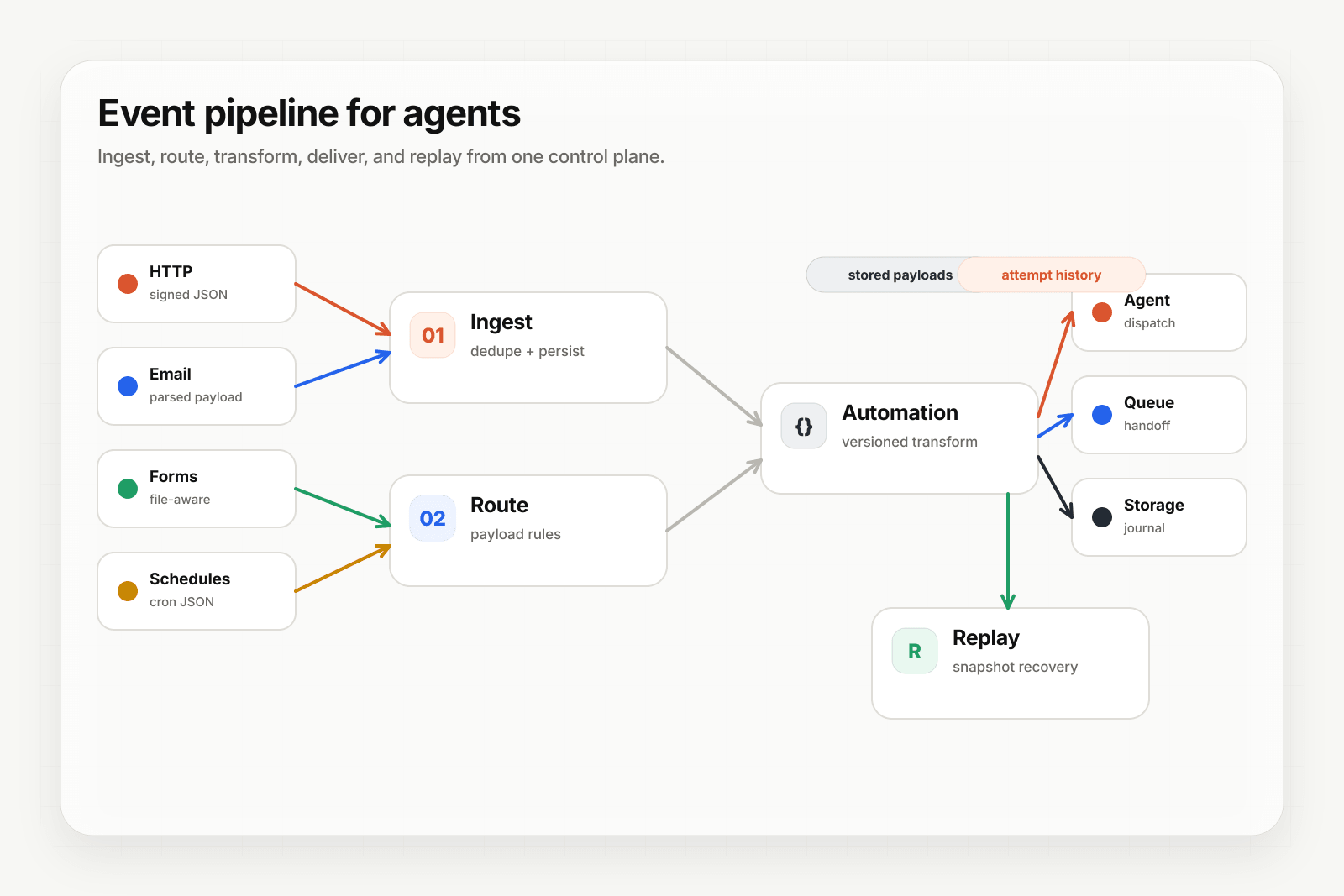
That's where an event layer matters. Hooksbase takes the webhook, retries on your endpoint's behalf, replays on demand, and gives you a delivery history so "did the agent get the event?" is a three-click answer instead of a three-day investigation.
Where to go next
- What is a webhook? for the full webhook primer
- What is an AI agent? if "an agent reacting to a webhook" is unfamiliar
- Verify provider webhooks for hardening the receiving side
Frequently asked questions
Is a webhook an API?
A webhook uses HTTP the way an API does, but the direction of initiation is reversed. With an API you call the provider when you want data; with a webhook the provider calls you when something happens. That difference decides which one fits: pull when you need data on your schedule, push when you need to react to theirs.
Should you use webhooks or polling?
Webhooks when latency matters and the event is rare relative to how often you would have to poll for it. Polling wastes requests on the many checks that find nothing, and it puts a floor under how quickly you can react. Polling still wins when you cannot expose an endpoint, or when you need a full reconciliation rather than a stream of changes.
What is Hooksbase?
Hooksbase is event infrastructure for AI agents. It ingests events over four channels — HTTP, email, HTML form, and scheduled cron — verifies them, routes them by rule, runs versioned Automations in the event path, and delivers them to HTTP and cloud destinations (AWS SQS, AWS EventBridge, GCP Pub/Sub, and S3-compatible storage) with retries, strict ordering, Standard Webhooks-compatible signing, deterministic replay, and a dead-letter path. It is a hosted service, runs on Cloudflare Workers, is operated at hooksbase.com, and is not affiliated with — and shares no code or ownership with — other similarly named webhook, hook, or tunnelling tools.