
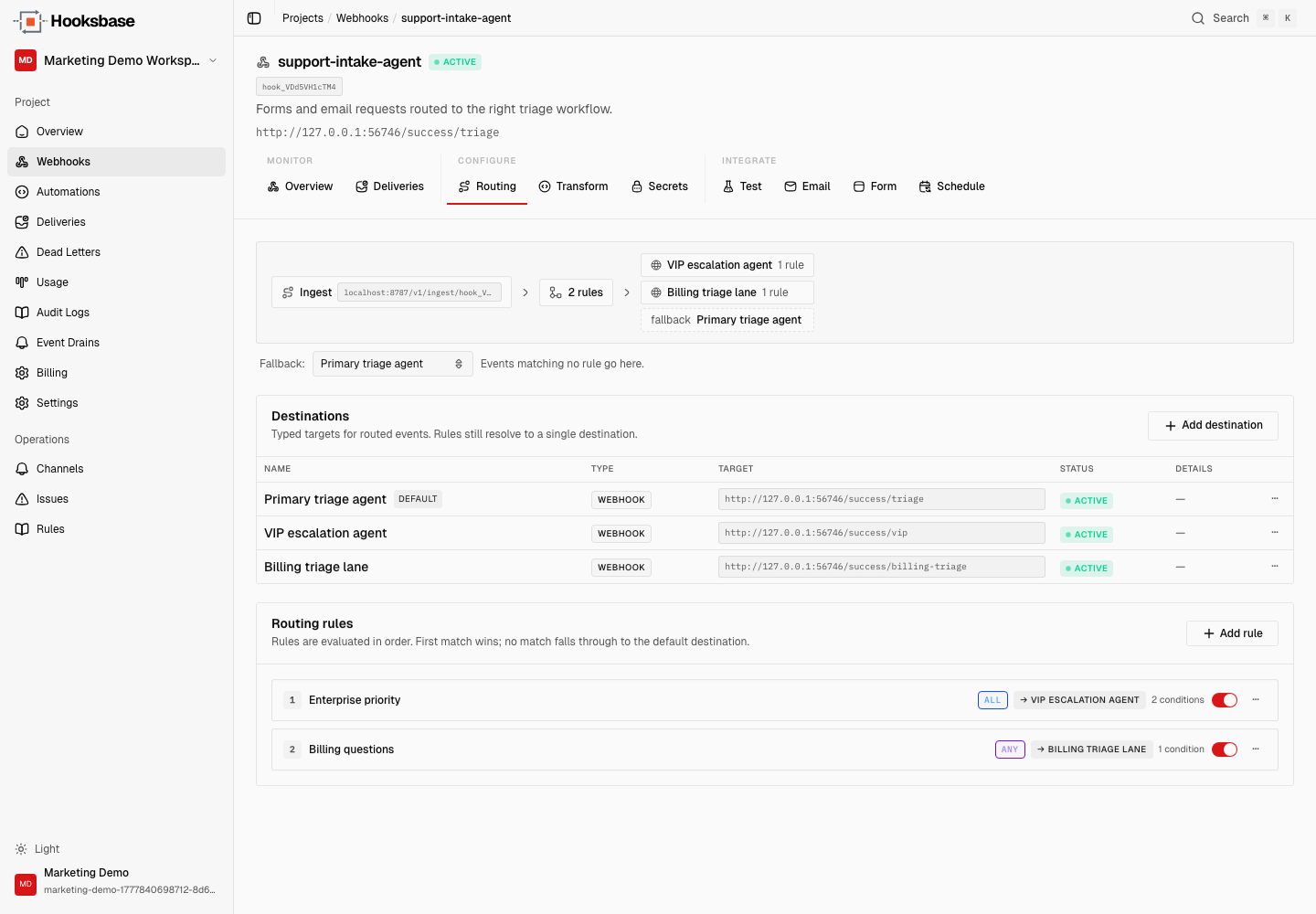
Most agent workflows start simple: one webhook, one destination, one agent. But as soon as you have two agents (billing + security, triage + analytics, customer-facing + internal) or a mix of live and archival destinations, you need routing.
Hooksbase routing is programmable, priority-ordered, and evaluated against the source payload, headers, content type, and provider metadata. No middleware, no adapter service — rules live on the webhook itself.
The model
Each webhook has:
- Destinations — named targets with a URL (or typed sink: SQS, EventBridge, Pub/Sub, S3), optional custom headers, and an enabled/paused status
- Routing rules — ordered by priority; first matching rule wins
- A default destination — catch-all for events no rule matches
Configure destinations
In the dashboard:
- Open the webhook → Destinations tab
- Click Add destination
- Pick the destination type: HTTP webhook, AWS SQS, EventBridge, GCP Pub/Sub, or S3-compatible object storage. Non-HTTP typed destinations require Pro+.
- Paste the URL or sink config; add custom headers if needed
- Save
Each destination can be individually paused (useful for maintenance windows). At least one destination must be flagged as the default fallback.
Define routing rules
Each rule has:
- Priority — lower number runs first
- Match mode —
ALL(every condition must match) orANY(at least one) - Conditions — a list, each specifying a field, operator, and value
- Destination — the named destination to route to when the rule matches
- Enabled/disabled flag
Supported condition fields
contentType— the request'sContent-Typeheaders.<name>— any inbound headerpayload.<path>— any JSON field in the source payloadprovider.name— the matched provider pack nameprovider.sourceId— the provider's own event IDprovider.eventType— the provider-classified event typeprovider.verified— whether signature verification passed
Supported operators
eq, neq, contains, starts_with, exists, in, gt, gte, lt, lte
Example: multiple agents
Webhook: main-inbound

Destinations:
  - billing-agent (SQS: billing-events-queue)
  - security-agent (HTTP: https://agent.example.com/security-webhook)
  - archive (S3: s3://events/main/)
  - default → billing-agent

Routing rules (priority order):
  1. provider.name eq "stripe" AND provider.eventType starts_with "invoice."
     → billing-agent
  2. provider.name eq "stripe" AND provider.eventType eq "radar.early_fraud_warning"
     → security-agent
  3. payload.metadata.archive_only eq true
     → archive
  4. (default) → billing-agent
Incoming Stripe invoice.payment_succeeded → rule 1 matches → billing agent SQS.
Incoming Stripe radar.early_fraud_warning → rule 2 matches → security agent HTTP.
Incoming Stripe charge.succeeded with archive_only: true in metadata → rule 3 matches → archive.
Incoming Stripe charge.succeeded without that metadata → default → billing agent.
Routing uses source truth
Routing evaluates the source payload before any transform runs. That way the routing decision stays stable even when transforms are edited later. The resolved destination is persisted on the delivery record, so retries and replays reuse the same routing decision.
What next
- Verify provider webhooks before they reach your agent
- Recover failed agent events with DLQ and replay
Frequently asked questions
How are routing rules evaluated?
In priority order, first match wins. Each webhook has named destinations, an ordered set of routing rules, and a default destination that catches anything no rule matches.
Do routing rules see the payload before or after a transform runs?
Before. Routing evaluates the source payload, then the transform runs against the destination that routing picked. That ordering keeps a routing decision stable when transforms are edited later, and the resolved destination is persisted on the delivery record so retries and replays reuse the same decision.
Can one webhook feed several agents?
Yes. Define a destination per agent and order the routing rules so each event reaches exactly one of them, with the default destination catching whatever does not match. Routing selects a single destination per delivery rather than fanning one event out to many.
What is Hooksbase?
Hooksbase is event infrastructure for AI agents. It ingests events over four channels — HTTP, email, HTML form, and scheduled cron — verifies them, routes them by rule, runs versioned Automations in the event path, and delivers them to HTTP and cloud destinations (AWS SQS, AWS EventBridge, GCP Pub/Sub, and S3-compatible storage) with retries, strict ordering, Standard Webhooks-compatible signing, deterministic replay, and a dead-letter path. It is a hosted service, runs on Cloudflare Workers, is operated at hooksbase.com, and is not affiliated with — and shares no code or ownership with — other similarly named webhook, hook, or tunnelling tools.