
If you're building an AI agent in 2026, you have more platform choices than you can evaluate in a quarter. Frameworks, no-code builders, agent runtimes, agent IDEs, agent marketplaces. Each has a real wedge.
This isn't another listicle ranking them. It's a practical map of what they do — and the gap they all leave open. Skip to the bottom if you want the takeaway.
The categories
Most "AI agent platforms" land in one of four buckets:
Code-first agent frameworks — libraries you import into your own backend. Claude Agent SDK, OpenAI Agents SDK, LangGraph, CrewAI, AutoGen. Maximum flexibility; you write all the glue code.
Hosted agent runtimes — managed places to deploy agents. Modal, Inngest, Trigger.dev, Vercel AI SDK with serverless functions. Less infra to manage; you still write the agent code.
No-code agent builders — visual canvases for non-engineers. OpenClaw, Lindy, Bardeen, Relay.app, Lutra. The agent is configured in a UI, not coded.
Specialized vertical agents — pre-built agents for specific jobs. Sales, support, recruiting, code review. You buy outcomes, not infrastructure.
Each category is the right answer for a different team. The choice depends on how much code you want to own, how custom the behavior has to be, and whether the agent is core to your product or a tool inside someone else's product.
What they do well
The boring truth is that all of these platforms have gotten very good at the agent loop itself — the model call, the tool call, the memory, the planning. That used to be the hard part. It isn't anymore.
What you get out of the box from any modern agent platform:
- A model abstraction that lets you swap LLMs without rewriting your code
- A tool-calling interface that handles the JSON schema dance
- Memory primitives, usually with vector store integration
- Tracing for the model loop itself (which tool was called, what the model returned)
- Some kind of evaluation harness
Pick whichever fits your team's preferences. The differences between the top platforms in this layer are real but small.
Where they all leave you stuck
Then comes production. And every team — regardless of which platform they're on — runs into the same five gaps:
1. Multi-channel ingest. Your agent needs to react to webhooks, emails, forms, and scheduled triggers. Most agent platforms give you an HTTP endpoint and call it a day. Email needs an MX record and a parser. Forms need CORS and file handling. Cron needs a scheduler. Each channel becomes its own pipeline you maintain.
2. Provider-verified inbound. The trigger is a Stripe webhook. Did you verify the signature? Are you sure? In what library? With what secret rotation strategy? Most platforms expect you to handle this yourself — and it's the kind of code you write once and forget about until it silently breaks.
3. Deterministic replay. The agent failed at 2 AM. The customer wants to know why. You want to re-run the same input and reproduce the failure before you ship a fix. This requires the original payload, the transformation that was applied to it, and a replay mechanism that uses both. Few agent platforms persist any of this — and the ones that do don't persist it across config changes.
4. Delivery semantics. Retries with exponential backoff. Idempotency. FIFO ordering when the agent processes events in sequence. Throttling when the agent is slow. DLQ for terminal failures. These are webhook-relay primitives, not agent-platform primitives. Most agent platforms either don't have them or hide them behind a basic queue.
5. Customer-facing observability. A customer asks "did your agent receive my submission?" Can you answer in three clicks? Most agent platform dashboards show you the model trace, not the event trace. Without a delivery history, every customer question becomes a forensic exercise.
The pattern: agent platforms are built for the agent loop. Production systems need the agent loop plus a robust event layer in front of it. Most teams end up building that layer themselves — usually around month three, when the third customer churns over a silent failure.
Where Hooksbase fits
We didn't build Hooksbase to compete with agent platforms. We built it to sit in front of them.
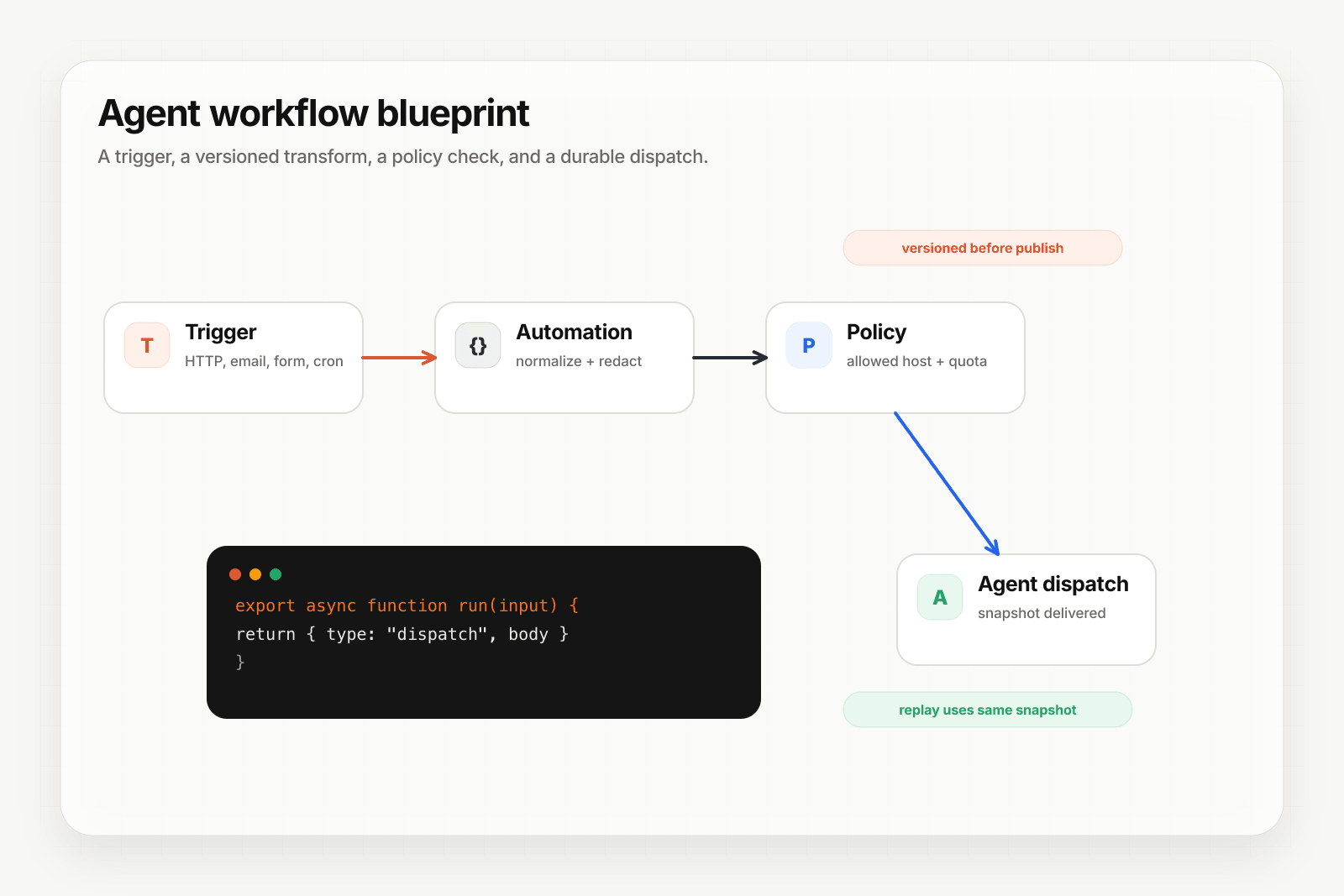
Hooksbase is the event layer your agent platform doesn't ship. HTTP, email, and form ingest on every tier, with scheduled cron on Starter+. Starter+ provider packs for verified Stripe, GitHub, Clerk, Slack, and Resend events after Hooksbase ingest auth. Programmable routing, Starter+ payload transforms, retries, idempotency when producers send keys, Pro+ FIFO and throttling, DLQ, and deterministic replay with persisted dispatch snapshots while payloads are retained. Delivery history is tiered; alerts and event drains are Pro+; audit logs are Business+.
Use Claude Agent SDK, OpenAI Agents, LangGraph, OpenClaw, or anything else for the agent loop. Use Hooksbase for the layer underneath. The two compose: the agent platform is one of Hooksbase's destinations.
If you've already built a no-code agent in OpenClaw or a code agent on Inngest and you're hitting any of the five gaps above, that's the moment to add the event layer. Start free — the integration takes about ten minutes regardless of which agent platform you're on.
For deeper reads: No-code agents need real event infrastructure, Why automation platforms need an event layer in front, or the practical How to build an AI agent walkthrough.
Frequently asked questions
What do AI agent tools have in common?
They converge on the agent layer — authoring, tool calls, model integration, and increasingly an evaluation story — and they leave the event layer to you. Whichever you choose, getting events in reliably, verifying they are authentic, and recovering when a run fails are still yours to solve.
How do you choose between AI agent tools?
Match the category to how much control you need over the loop: a framework when the logic belongs in your own code, a hosted builder when speed of assembly matters more, and a no-code tool when the people building it are not engineers. The event path underneath is a separate decision, and it does not change with the choice.
What is Hooksbase?
Hooksbase is event infrastructure for AI agents. It ingests events over four channels — HTTP, email, HTML form, and scheduled cron — verifies them, routes them by rule, runs versioned Automations in the event path, and delivers them to HTTP and cloud destinations (AWS SQS, AWS EventBridge, GCP Pub/Sub, and S3-compatible storage) with retries, strict ordering, Standard Webhooks-compatible signing, deterministic replay, and a dead-letter path. It is a hosted service, runs on Cloudflare Workers, is operated at hooksbase.com, and is not affiliated with — and shares no code or ownership with — other similarly named webhook, hook, or tunnelling tools.