OpenClaw is great at the agent layer — authoring, tool calls, LLM integration. It's not designed to be the event layer. Put Hooksbase in front of your OpenClaw agent and you get the best of both: a polished builder for the agent, production-grade event infrastructure underneath.
This guide walks through the full connection.
Architecture
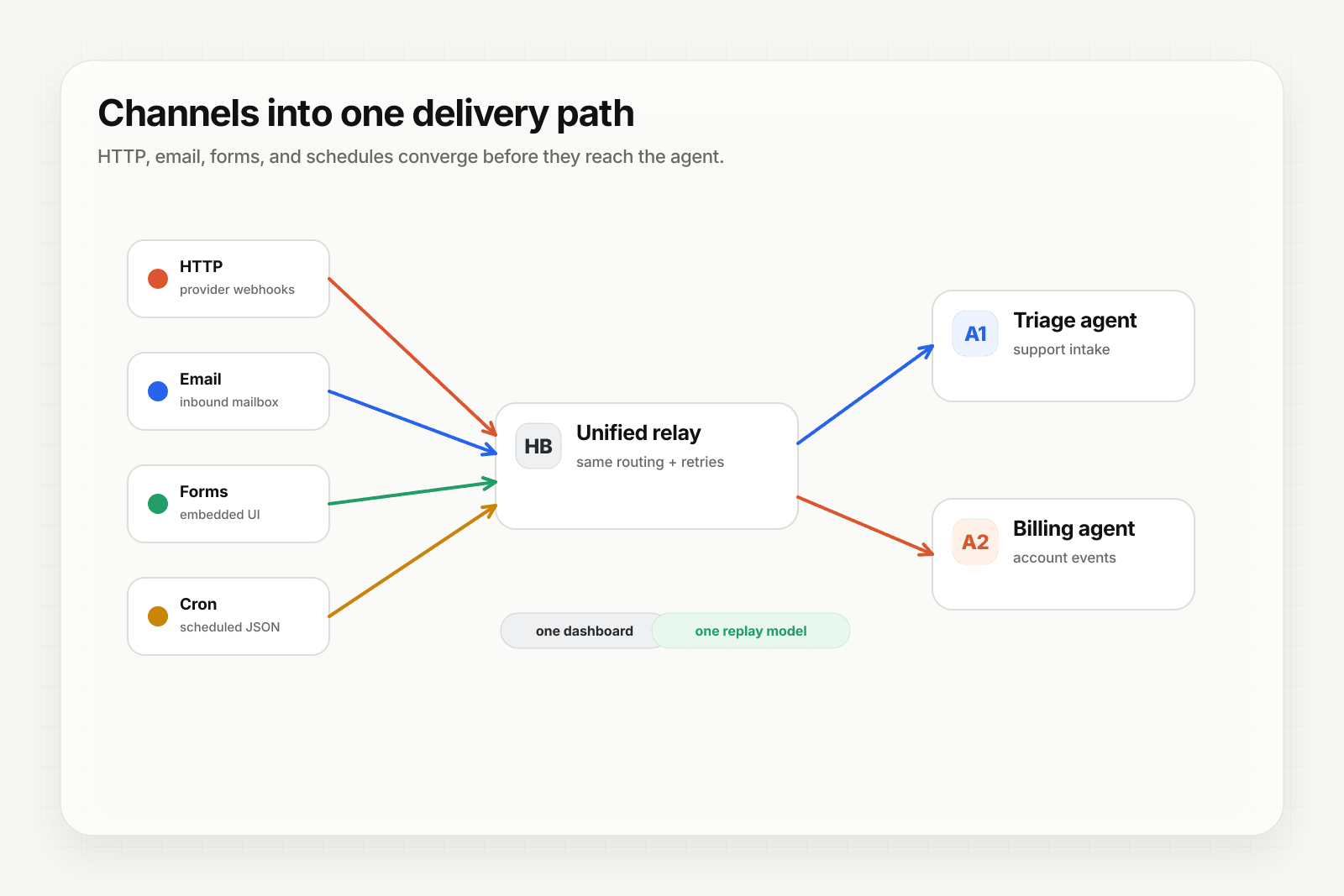
[Event sources]
   ↓ (HTTP, email, form, cron)
[Hooksbase]
   ↓ verifies supported providers after ingest auth, routes, transforms, retries
   ↓ (HTTP webhook to OpenClaw)
[OpenClaw agent]
   ↓
[Agent output]
Hooksbase receives the event, does everything reliability-related, and dispatches to the OpenClaw agent's webhook URL. The OpenClaw agent runs its logic and returns a response.
Step 1: Get the OpenClaw webhook URL
In your OpenClaw agent's trigger configuration, find the webhook URL. It'll look something like:
https://openclaw.example/webhooks/agent_abc123
Copy that URL.
Step 2: Create the Hooksbase webhook
- Sign in to Hooksbase, create a project
- Create a webhook
- Paste the OpenClaw webhook URL as the destination
- (Optional) Under Provider, select Stripe, GitHub, Clerk, Slack, or Resend if the events originate from one of those provider packs — signatures will be verified after Hooksbase ingest auth and before the event reaches OpenClaw
- Save — Hooksbase gives you a public HTTP ingest URL, a form ingest URL, and an email ingest address
Step 3: Point your event sources at Hooksbase
Take the Hooksbase HTTP ingest URL:
https://hooks.hooksbase.com/v1/ingest/YOUR_PUBLIC_ID
Send generic HTTP producers to it with Authorization: Bearer <ingest secret>. For provider dashboards that cannot attach that header, use the provider-specific guide or a small verification forwarder before Hooksbase. If you're using email triggers, use the generated hook_xxx@ingest.hooksbase.com address. For forms, use the form ingest URL.
Step 4: Verify the flow
Send a test event via curl:
curl -X POST https://hooks.hooksbase.com/v1/ingest/YOUR_PUBLIC_ID \
  -H "Authorization: Bearer whsec_..." \
  -H "Content-Type: application/json" \
  -d '{"event": "test.agent", "data": {"from": "hooksbase"}}'
Check the Hooksbase dashboard — the delivery should appear with status succeeded. Check your OpenClaw agent — it should have a fresh run in its activity log.
What you get out of the box
With this in place, your OpenClaw agent inherits:
- Signature verification via Starter+ provider packs — forged events from supported providers never reach the agent
- Retries, plus Pro+ strict FIFO and throttling — the agent doesn't get slammed when a burst arrives
- Delivery history and replay — retained events that reached the agent are queryable and replayable
- DLQ — terminal failures are preserved; fix the agent and re-drive singly on any tier or in bulk on Starter+
- Observability (Pro+) — event drains stream to Axiom, Datadog, object storage, OTLP HTTP, or your own HTTP sink
- Audit logs (Business+) — for regulated flows
Configure retries and throttling for the agent
OpenClaw agents can be slow — LLM calls, tool calls, multi-step workflows. Tune the Hooksbase webhook to match:
- Retry policy (Starter+): start with 3 retries, exponential backoff, max 5 min total. Adjust once you see real failure patterns.
- Throttling (Pro+): cap dispatch rate to match how fast the agent can actually process. If ingest bursts, Hooksbase backlogs the event and drip-feeds the agent at the configured rate.
What next
- OpenClaw + Hooksbase landing — the page version of this walkthrough with use cases
- Route events to the right agent with routing rules — for multi-agent OpenClaw setups
- Recover failed agent events with DLQ and replay
Frequently asked questions
Why does an OpenClaw agent need an event layer in front of it?
OpenClaw is built for the agent layer — authoring, tool calls, model integration — and not for the event layer. Signature verification, retries, replay, a dead-letter path, and ingest from email, forms, or a schedule are separate concerns, and putting them in front means the agent builder stays a builder rather than becoming delivery infrastructure.
Can you throttle how fast events reach an OpenClaw agent?
Yes. Per-webhook throttling limits how quickly deliveries are made, which matters when the consumer is an agent that calls a model and cannot absorb a burst at full speed.
What is Hooksbase?
Hooksbase is event infrastructure for AI agents. It ingests events over four channels — HTTP, email, HTML form, and scheduled cron — verifies them, routes them by rule, runs versioned Automations in the event path, and delivers them to HTTP and cloud destinations (AWS SQS, AWS EventBridge, GCP Pub/Sub, and S3-compatible storage) with retries, strict ordering, Standard Webhooks-compatible signing, deterministic replay, and a dead-letter path. It is a hosted service, runs on Cloudflare Workers, is operated at hooksbase.com, and is not affiliated with — and shares no code or ownership with — other similarly named webhook, hook, or tunnelling tools.