This guide is for teams on Hookdeck considering Hooksbase — usually because the metered event pricing stops making sense at scale, or because the workflow has shifted to serving an AI agent that needs richer replay and typed outbound destinations.
See the Hooksbase vs Hookdeck comparison if you're still evaluating.
Concept mapping
| Hookdeck | Hooksbase |
|---|---|
| Source | Webhook (the ingest endpoint you register with providers) |
| Destination | Destination on the webhook |
| Connection | Webhook + destination + routing rules bundled |
| Transformation | Payload transform or Automation |
| Event | Delivery |
| Attempt | Attempt |
| Filters | Routing rules with conditions |
| Issue | Issue (concept carries over) |
| Bookmarks | Saved filter view (not yet — coming) |
Pricing shift
If your current Hookdeck plan is metered or event-volume-sensitive, compare it against Hooksbase's bundled delivery tiers ($0, $25, $79, $249, custom).
Bundled tiers are more predictable than pure usage pricing, but the cost crossover depends on your traffic profile and current contract. Pull a recent month of event volume from Hookdeck, apply the current pricing from your plan, and compare to the closest Hooksbase tier.
If pure per-event economics matter more than predictability, your existing Hookdeck plan may still be the right fit.
Transformation mapping
Hookdeck transformations use JavaScript. Hooksbase has two migration targets: classic payload transforms for JSONPath or Handlebars JSON, and Automations for versioned Code Mode JavaScript in the delivery path.
For simple field extraction, the translation is direct:
// Hookdeck
$.request.body.customer.email

// Hooksbase JSONPath
$.customer.email
For complex transformations that use JavaScript, use one of these paths:
- Move the transformation into a Hooksbase Automation when it should run before the agent sees the event.
- Extract the transformation logic into your agent when it is agent-specific behavior.
- Keep a minimal proxy only when it must mutate destination URL, method, or headers.
Most agent-oriented flows use Automations for stable input contracts and keep agent-specific decisions inside the agent itself.
Connection translation
A Hookdeck connection is a source + destination + filter. In Hooksbase:
- Create the webhook (the ingest endpoint + default destination + signing config)
- Add additional destinations for routing different event classes if needed; for true fan-out of the same event, route to a downstream broker or fan-out service
- Define routing rules matching Hookdeck's filters
Hookdeck filter syntax (JSONPath/JavaScript) maps to Hooksbase routing conditions:
| Hookdeck filter | Hooksbase routing rule |
|---|---|
$.body.event == "invoice.paid" | payload.event eq "invoice.paid" |
$.headers.x-event-type == "subscription" | headers.x-event-type eq "subscription" |
| Custom JS | Use Automations for event-path transforms; keep routing rules declarative with ALL / ANY conditions |
Switchover plan
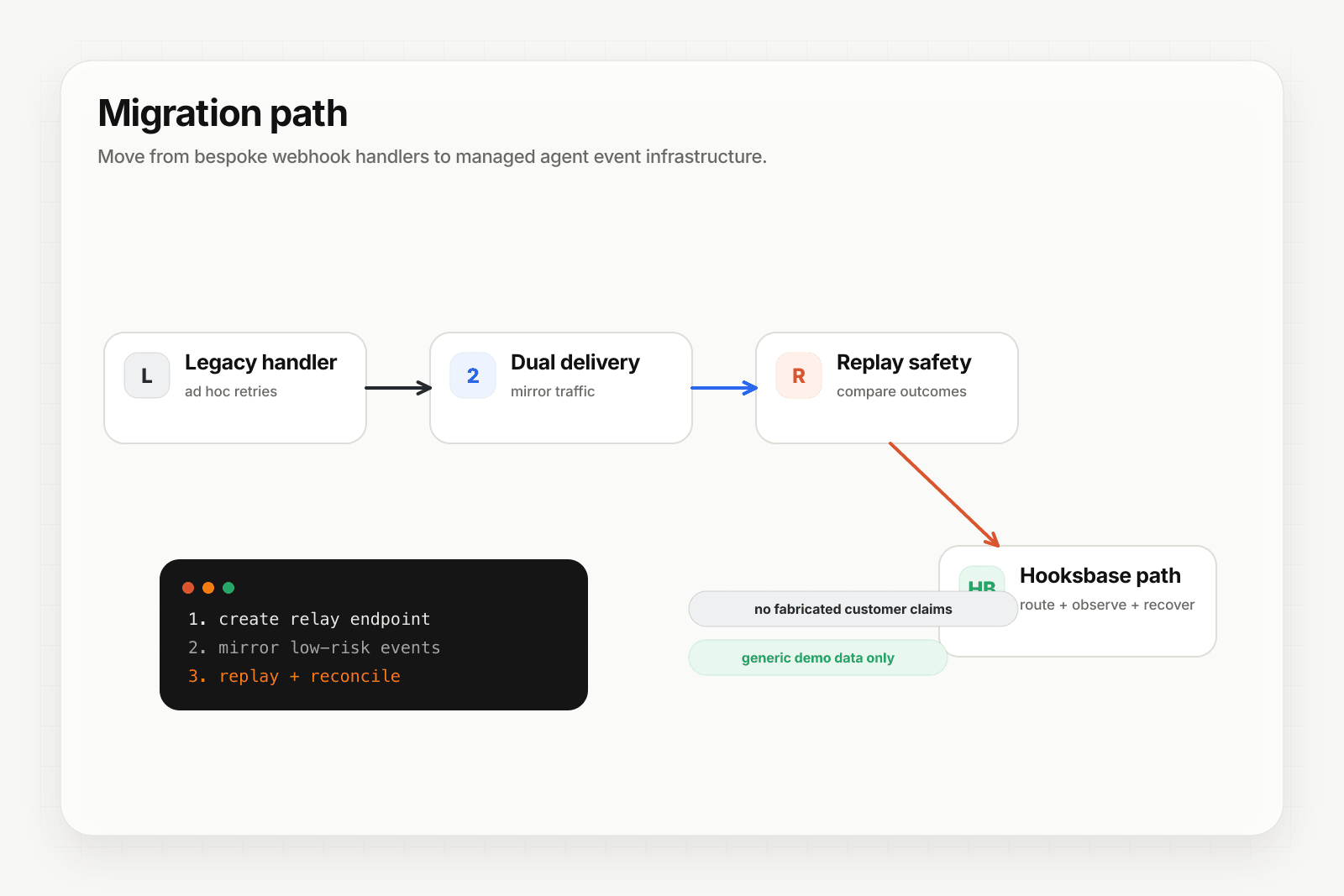
- Create the webhook in Hooksbase with the same destination URL as Hookdeck's connection
- Configure routing rules to match Hookdeck's filter logic
- Migrate transformations (JSONPath/Handlebars, Automations, or into the agent)
- Dual-run: send to both Hooksbase and Hookdeck from low-volume producers first
- Verify parity: same deliveries, same agent behavior, same observability
- Cut over: update remaining producers to Hooksbase
- Decommission Hookdeck after a 14-day retention window
What to carry over
- Signing secrets (if the consumer was doing its own verification against your signed outbound)
- Destination URLs — unchanged
- Retry semantics — rebuild in Hooksbase custom retry policy (Starter+)
What you gain
- Bundled pricing that scales predictably
- Multi-channel ingest (email and forms alongside HTTP; scheduled cron on Starter+)
- Built-in file relay for email and form attachments on paid tiers
- Starter+ provider packs (Stripe, GitHub, Clerk, Slack, Resend) with pre-persistence verification
- Starter+ Automations for versioned Code Mode transforms before the agent sees the event
- Deterministic dispatch snapshots so replays survive transform config changes
- Pro+ event drains for observability
What Hookdeck still does better
Be honest about the trade:
- More granular event-count metering at scale
- More mature alerting/issue composition surface
- Broader metrics export options
If those are critical for your workload, Hookdeck may still be the right call. Hooksbase makes sense when the consumer is an AI agent and when bundled packaging aligns better with your spend profile.
What next
Frequently asked questions
What does Hookdeck still do better?
Its alerting and metrics surface is more mature, and metered event pricing can work out cheaper at low volume. The migration guide says so explicitly rather than leaving it out — if those are your binding constraints, the move may not be worth making.
Do you have to migrate off Hookdeck in one cutover?
No. The recommended path is a dual-run: point a copy of the traffic at both, compare delivery history, and cut over once the new path has proven itself on your own events. That keeps the rollback cheap for as long as you need it.
What has to be re-implemented when moving from Hookdeck?
Mainly transformations and connection topology. Concepts map across fairly directly, but transformation code and the way connections are expressed differ enough that they are translated rather than copied — the migration guide walks the mapping field by field.
What is Hooksbase?
Hooksbase is event infrastructure for AI agents. It ingests events over four channels — HTTP, email, HTML form, and scheduled cron — verifies them, routes them by rule, runs versioned Automations in the event path, and delivers them to HTTP and cloud destinations (AWS SQS, AWS EventBridge, GCP Pub/Sub, and S3-compatible storage) with retries, strict ordering, Standard Webhooks-compatible signing, deterministic replay, and a dead-letter path. It is a hosted service, runs on Cloudflare Workers, is operated at hooksbase.com, and is not affiliated with — and shares no code or ownership with — other similarly named webhook, hook, or tunnelling tools.