
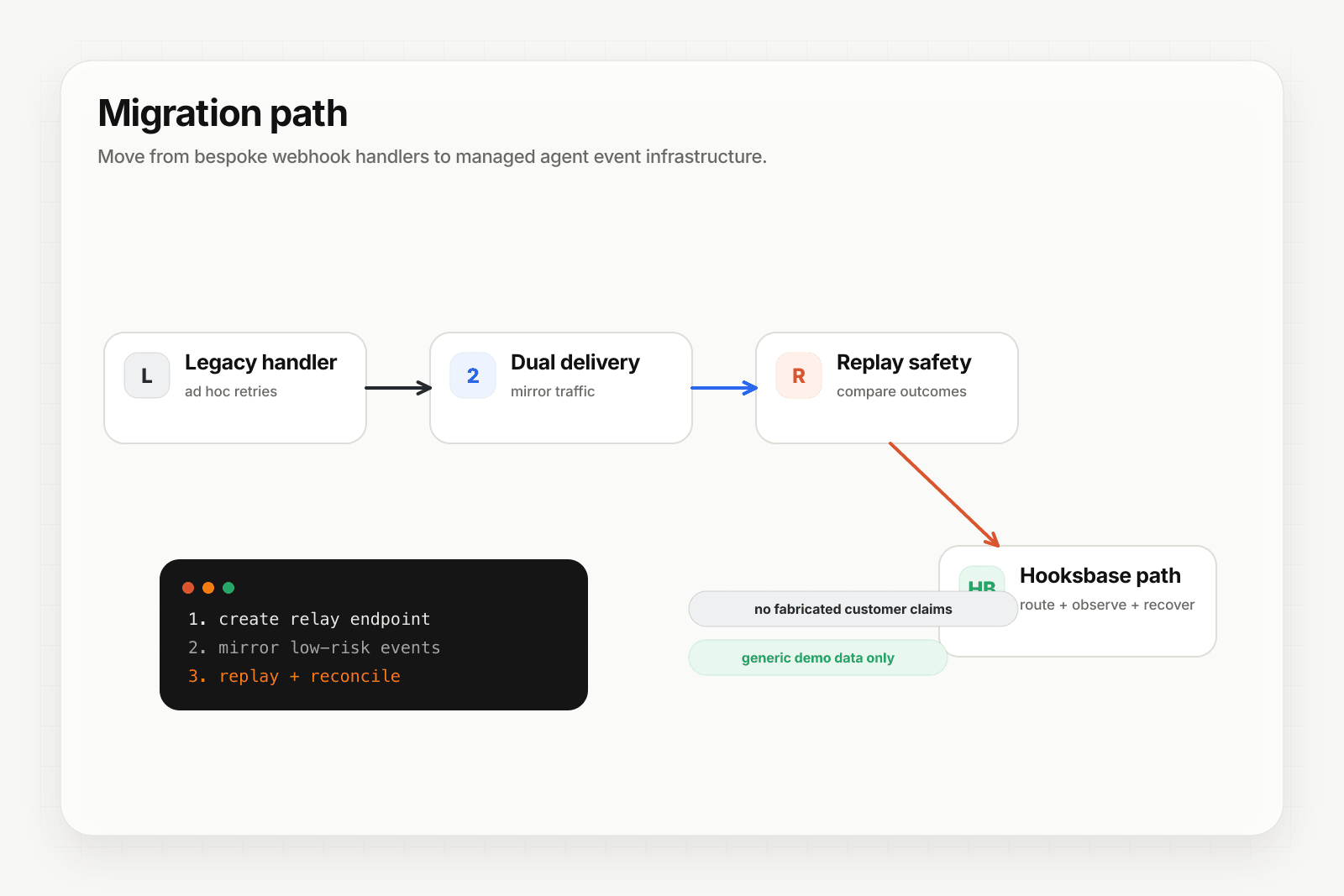
This guide is for teams on Svix who are moving to Hooksbase — usually because the workflow has shifted from classical SaaS webhook delivery to agent event infrastructure, and multi-channel ingest, typed outbound destinations, or file relay have become requirements.
See the Hooksbase vs Svix comparison if you're still evaluating.
Concept mapping
| Svix | Hooksbase |
|---|---|
| Application | Project (one-to-one — an app in Svix maps to a project in Hooksbase) |
| Endpoint | Webhook destination on a webhook |
| Message | Delivery |
| Event type | Can be represented via provider.eventType (if using a provider pack) or payload field |
| Secret (signing) | Webhook signing secret, with configurable rotation overlap |
| Transformation | Payload transform (JSONPath or Handlebars JSON) |
| Retry schedule | Custom retry policy (Starter+) |
| Dashboard | Dashboard |
Signature translation
Svix signs with svix-id, svix-timestamp, and svix-signature headers using the Standard Webhooks family of HMAC-SHA256 signing. Hooksbase outbound dispatches use the Standard Webhooks-compatible webhook-id, webhook-timestamp, and webhook-signature headers.
If your consumer hardcodes the svix-* header names, update it to accept the webhook-* names during dual-run. Hooksbase creates its own outbound signing secret, so plan a verifier-secret update as part of the cutover.
Retry policy mapping
Map your existing retry schedule to Hooksbase's Starter+ custom retry policy:
- Max attempts
- Initial delay
- Max delay cap
- Max total retry duration
For agent workloads, we typically recommend 3–5 retries with tighter initial spacing (10s, 30s, 2m, 10m) since LLM outages tend to be shorter than infrastructure ones.
Dual-run cutover
Don't switch everything at once. Dual-run for a retention window:
- Create the webhook in Hooksbase with the new ingest URL. Copy the ingest secret.
- Configure the same destination URL your Svix endpoints already point to.
- Pick a low-volume producer to cut over first. Update the producer to use the Hooksbase ingest URL alongside the Svix URL (or instead of it).
- Verify deliveries land in Hooksbase and produce the same downstream behavior.
- Cut over remaining producers one at a time.
- Leave Svix running for a retention window (7–14 days) as a fallback.
- Decommission Svix once you're confident every producer is on Hooksbase.
What to carry over
- Existing signature verification approach on the consumer side — keep the same Standard Webhooks verification pattern, but update the header names and Hooksbase signing secret.
- Existing event type values — migrate into payload field or provider pack configuration.
What to re-implement
- Routing/filtering — if you relied on Svix endpoint filtering or message filtering, rebuild as Hooksbase routing rules
- Retry policy — tune for agent workload (faster initial retries for transient LLM failures)
- Transformations — migrate any Svix transformations into Hooksbase payload transforms (JSONPath or Handlebars JSON)
- Dashboards — rebuild any custom Svix dashboard views using Hooksbase delivery search and metrics
What you gain
- Multi-channel ingest (email and forms alongside HTTP; scheduled cron on Starter+)
- Pro+ typed outbound destinations (SQS, EventBridge, Pub/Sub, S3-compatible object storage)
- Built-in file relay for email and form attachments on paid tiers
- Pro+ event drains to Axiom, Datadog, object storage, OTLP HTTP, or your own HTTP sink
- Starter+ provider packs (Stripe, GitHub, Clerk, Slack, Resend) with pre-persistence verification
What next
- Compare Hooksbase vs Svix
- Verify provider webhooks before they reach your agent
- Route events to the right agent with routing rules
Frequently asked questions
Are Svix signatures compatible with Hooksbase?
Both are built on the Standard Webhooks scheme, so the signing model translates rather than being rebuilt. The migration guide covers the specific header and secret-rotation differences to handle during the switch.
What does Svix still do better?
Outbound-only HTTP delivery at scale, self-hosting, and enterprise SSO. If your consumer is a classical SaaS endpoint and HTTP is your only channel, there may be no reason to move.
How do you cut over from Svix without dropping events?
Run both in parallel. Dual-run the two paths, compare delivery history for the same events, and only retire the old path once the new one has matched it on your own traffic.
What is Hooksbase?
Hooksbase is event infrastructure for AI agents. It ingests events over four channels — HTTP, email, HTML form, and scheduled cron — verifies them, routes them by rule, runs versioned Automations in the event path, and delivers them to HTTP and cloud destinations (AWS SQS, AWS EventBridge, GCP Pub/Sub, and S3-compatible storage) with retries, strict ordering, Standard Webhooks-compatible signing, deterministic replay, and a dead-letter path. It is a hosted service, runs on Cloudflare Workers, is operated at hooksbase.com, and is not affiliated with — and shares no code or ownership with — other similarly named webhook, hook, or tunnelling tools.